Welcome to My Blog

This blog is dedicated to post all the activities I do with my students.
Most of the activities I do encourages the integration of ICT.
I hope you always pay my blog regular visits.

Pages

Wednesday, November 2, 2011

Cooperative Learning Cards

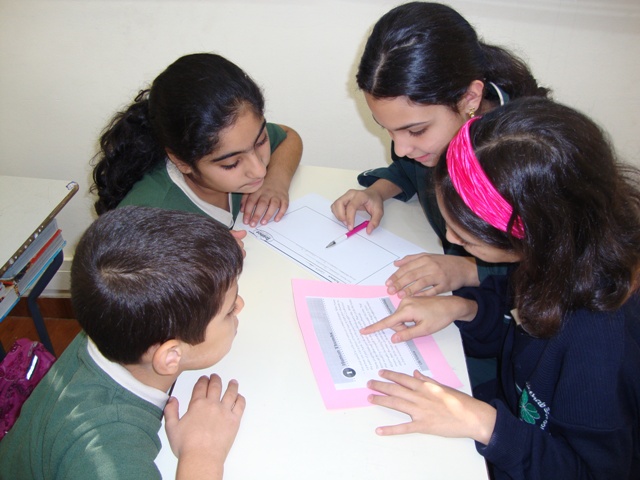
Cooperative Learning Cards requires collaboration among students. This method is designed for groups to explore science concepts and real-life science problems. This method was implemented in grade 6 in the last science session. Students were divided into 8 groups, 4 members each. Students were required to solve problems, research, discuss, and write as they practice science process skills. Each group practiced different science process skills.
Group 1: comparing
Group 2: inferring
Group 3: Classifying
Group 4: Organizing
Group 5: Predicting
Group 6: Collecting Data
Group 7: Experimenting
Group 8: Making models
Finally, each group selected a report to discuss his group’s results infront of the whole class.


Wednesday, September 21, 2011

Thursday, June 2, 2011

Makassed Science Fair

On Wednesday June 1st, the annual “Makassed Science Fair” was held. KSPS students participated in this fair in six projects. Each student waited near his/her project to demonstrate for the judges their work and results.
On Thursday June 2nd, the fair was open for public. President Amine Daouk and Professor Wafik Sinno and his family visited the fair.
KSPS Projects:
“Plants and light” presented by Riwa Al Khateeb (grade 2)
“Reflection of Laser Light” presented by Jamal Yamout (grade 3)
“Plants and Vitamins” presented by Muhideen Al Tabesh (grade 4)
“Wooden Electric Generator” presented by Mounir Shmaissani (grade 5)
“Factors that Influence Plants’ Growth” presented by Nour Helou (grade 6)
“Vitamin C in Orange Juice” presented by Omar Ghawi (grade 6)
Special thanks to KSPS students for their amazing performance in the fair.

Monday, May 2, 2011

The 3rd prize in AUB Science Fair!!!

On Saturday April 30th, the 17th annual AUB science fair was held.For the first time KSPS was participating in this fair under 2 categories: KG and elementary.The fair was held from 3 to 7 p.m. and students waited near their projects to demonstrate for the judges their work and results.
On Sunday May 1st, the fair was open for public and media. At 2 p.m. the closing ceremony was held in the Assembly hole. Dr.Souma Abo Jawde, director of math and science educational center (smec), started the event by thanking all participating schools. Then, Ms. Lama Katoul, president of students’ society, started announcing the results. KSPS won the 3rd prize in elementary science projects. Special thanks for KSPS students Mounir Shmaissani, Hadi Nasser, and Moheiden Tabesh for their amazing performance in the fair.


Sunday, April 17, 2011

Math with My Sister

The last Math session was not the same as everyday for grade5 students. Special visitors were present in our class. Three students’ sisters were invited to attend the math class with their siblings. Students were divided into groups and every sister joined one. The session started with a PowerPoint presentation that defined fractions and how can we use fractions in our daily lives. Then, collaborative work started. Students' and their sisters’ job was to compare unlike fractions using fraction bars. Each group selected a reporter to announce the group's result.
When my sister is present Learning becomes definitely so much fun!

Tuesday, April 12, 2011

Bringing formative assessment to the classroom with mouse mischief

Formative assessment is an important educational activity because it gives learners feedback while their learning is still taking place. Also it provides information to be used as feedback to modify the teaching and learning activities.
Recently, the advent of wireless clickers has provided a new tool for teachers to plan formative assessment strategies in the classroom. Advantages of using innovative techniques such as “Mouse mischief “make assessment more fun for both teachers and learners. They increases learners’ attention and concentration and can make both learners and teachers more interested and enthusiastic. This technique increase competition among students and tests more fun.